
LATEST ARTICLES

Visual Hierarchy in Packaging: Positioning Your Logo, Text, and Imagery

Packaging is a form of communication. Before a consumer reads the ingredients, compares claims, or notices sustainability certifications, the box has already made a series of decisions for them—what to look at first, how to read the product, and in some cases, how to feel about the brand. That choreography is what designers call visual hierarchy, and in packaging it is not just a design tool; it is a commercial weapon.

Hierarchy Is Not Decoration—It’s Navigation

The most common misconception is that hierarchy exists to “make the package look nice.” In reality, its function is navigation. A consumer’s eye has milliseconds to decode: What is this brand? What product category is this? What variant or shade? What claim matters?

This sequence changes depending on channel. In a pharmacy aisle, a skincare product competes against dozens of SKUs for attention in less than two seconds. Online, that same product must read clearly in a thumbnail or be compelling in a still image for an influencer’s unboxing. One surface, two different reading logics.

Logo vs Category: Who Leads?

Across beauty, wellness, and lifestyle categories, hierarchy often begins with a tension between brand and category. Prestige skincare and fragrance brands tend to reduce the prominence of their logo, relying on typography, surface finishes, and whitespace to do the heavy lifting. The message is: “You know who we are; we don’t need to shout.”

Mass and D2C brands do the opposite. The logo is bolder, brighter, and more central because brand trust is still being built. For new or challenger brands, visibility is leverage—high logo prominence accelerates recognition.

Chocolate and gourmet products add a third nuance: storytelling. Here, logos often share hierarchy with imagery—cacao origin, praline textures, seasonal themes—because flavor and indulgence are semiotic drivers.

Typography as Structure, Not Style

Typography is hierarchy’s backbone. It determines how information is read and remembered. In packaging, typography must solve three simultaneous challenges:

  1. Identification: brand + category
  2. Differentiation: variant + shade + flavor
  3. Justification: claims + certifications + benefits

Problems arise when these layers collapse. If “SPF 50” or “vegan collagen” is the wrong size, hierarchy breaks. Claims must be visible enough to influence purchase, but not so dominant that they overshadow the brand. Luxury brands often reduce claim prominence to preserve mystique. Mass brands give claims volume because function sells.

Color as a Traffic System

Color is one of the fastest visual cues in packaging. Beauty and wellness brands use Pantone precision to differentiate SKUs (e.g., Hydration vs Retinol vs Vitamin C). Chocolate uses warmth for “indulgence,” pastel for “artisanal,” and deep blacks for “premium.” Pharma uses blues and whites for “clinical clarity.”

Color is also critical for digital readability. A design that works beautifully on shelf can collapse in a 1080×1080 feed if contrast is poor. This is why modern brands test packaging in two environments: shelf testing and screen testing. One speaks to retail, the other to D2C.

Imagery: The Supporting Actor

Imagery should clarify what the product is or what it does—not distract from it. In skincare, photography is rare; packaging relies instead on typography, texture, and finish. In chocolate and confectionery, imagery often becomes an appetite trigger. In beauty tools, imagery performs explanation—brushes, rollers, and tech devices benefit from visual demonstration.

The most successful packaging treats imagery like casting: give it a role and the shot works. Let it compete with the logo and the scene collapses.

Shelf vs Feed: Two Different Economies of Attention

The rise of D2C and influencer marketing added a new variable: packaging is now designed for both shelf and feed. Shelf hierarchy prioritizes distance visibility and legibility. Feed hierarchy prioritizes tactile surfaces, color nuance, and unboxing sequences. Soft-touch and foil perform better on camera than gloss; interior printing makes unboxing posts more cinematic.

Beauty brands mastered this duality early, but chocolate, fragrance, and gifting categories are quickly following. The consumer journey has become hybrid—physical + digital—so hierarchy must anticipate both.

Hierarchy Is Strategy

Ultimately, visual hierarchy is strategy disguised as aesthetics. A carton that places brand first and claims second signals confidence. One that elevates claims signals functional value. One that elevates imagery signals indulgence or sensory storytelling.

The smartest brands are not the ones with the most expensive printing techniques, but the ones who understand what to emphasize—and what to intentionally whisper.

Packaging doesn’t just present the product; it introduces it. Hierarchy is the handshake.
Premium Finishes Explained: Foil, Embossing, Spot UV & More

When it comes to premium packaging, finishes are the silent persuaders. They don’t speak in slogans or bullet points; they speak through texture, reflectivity, and contrast. A luxury skincare box, a chocolate assortment, or a fragrance carton can look nearly identical in structure, yet feel worlds apart once finishes enter the scene. Understanding how finishes function—both aesthetically and psychologically—has become essential for brands competing in crowded categories.

Foil Stamping: The Currency of Visibility

Foil stamping is the oldest trick in the luxury playbook, but its longevity is not accidental. Human vision is wired to detect reflective surfaces. Foil doesn’t just shine; it catches attention faster than matte elements. In beauty and fragrance, silver and gold foil remain powerful signals of price and prestige. Chocolate and confectionery brands use it to communicate indulgence and craft. Even minimalist brands haven’t abandoned foil; they’re simply using it with more restraint—thin lines, micro-typography, or a logo rendered with surgical precision.

The sustainability conversation has pushed foil to evolve. Suppliers now offer recyclable foils and thinner gauge materials that perform the same visual magic with less environmental guilt. The result is foil that behaves less like decoration and more like typographic jewelry.

Embossing & Debossing: The Art of Tactility

Embossing and debossing are about elevation—but not just literally. Tactile finishes create trust and memory. When a consumer feels raised typography under their fingertips, the brain registers craftsmanship. It’s the same mechanism that makes hardcover books or leather goods feel more valuable than their cheaper alternatives.

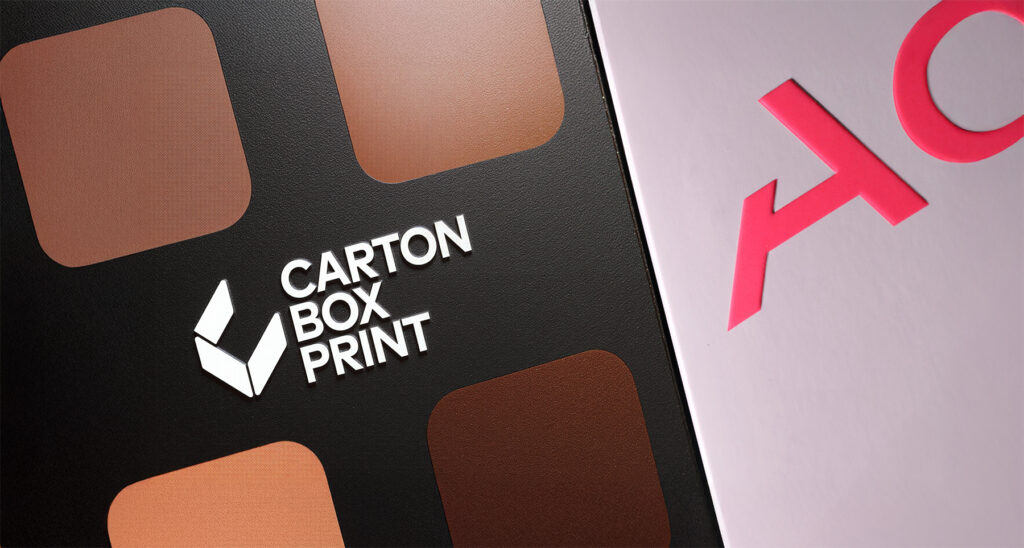
In packaging, embossing has become the emblem of “quiet luxury.” The trend favors texture over spectacle: subtle brand marks, tone-on-tone borders, or ingredient callouts rendered with precision. Debossing, the inverse technique, works especially well with soft-touch coatings, creating a sensory contrast that invites touch.

Psychologically, tactile finishes slow the consumer down. A matte panel or raised logo forces the hand to pause—an effect extremely valuable in beauty and gifting categories where unboxing is ritualized.

Spot UV: Contrast as a Design Tool

Spot UV is the medium for brands that want both restraint and drama. It highlights isolated elements—logos, claims, or patterns—without overwhelming the entire surface. On matte cartons, Spot UV behaves almost like condensation, catching the light at certain angles and disappearing at others. This subtle shifting is why tech and skincare brands favor it; it feels modern, engineered, and efficient.

Spot UV also helps tier products within a portfolio. A brand can reserve Spot UV for its prestige line while keeping mass or entry SKUs matte. This creates a laddered effect without redesigning the packaging system.

Soft-Touch: The Rise of Sensory Minimalism

Soft-touch coatings are the finish of the decade. Their velvety matte surface instantly communicates premium quality. In beauty and wellness, soft-touch has become the tactile language of “clean luxury.” It photographs beautifully—an underrated advantage in the age of influencer marketing and D2C unboxing videos. Unlike foil or holographic films, soft-touch delivers luxury quietly, without shouting for attention.

But the appeal runs deeper. Soft-touch taps into the consumer’s sensory expectations for skincare and fragrance. If the product claims smoothness, hydration, or refinement, the box’s surface reinforces that narrative before the jar or bottle even appears.

Holographic Films: Youth, Energy, and Play

If soft-touch is the language of calm, holographic finishes are the language of play. They appeal to color, motion, and novelty—qualities that thrive on social media. Holographic films are staples in K-beauty, hair care, and youth-driven D2C brands. They photograph aggressively well; they scream “share me.”

What’s changing is not the existence of holographic finishes, but their execution. Instead of covering the entire carton, designers now apply holography surgically—perhaps a corner panel, a lid, or a tiny logo burst. The result is less club, more couture.

Finishes as Brand Strategy, Not Decoration

The biggest misconception about premium finishes is that they are ornamental. In reality, they are strategic tools. A finish can communicate:

  • Price tier
  • Formulation story
  • Ingredient positioning
  • Category norms
  • Target audience
  • Retail channel
  • Seasonal vs core SKUs

Finishes help brands design hierarchy: what should the eye see first? What should the hand feel? What should the consumer remember?

The 2025 Finish Landscape

The new era is defined by balance: tactile + minimal + recyclable. Soft-touch paired with embossing, foil paired with restraint, Spot UV paired with matte. Luxury no longer means maximal; it means intentional.

Premium finishes are not simply surface effects. They are how packaging speaks without words—how it conveys promise, price, and personality before the product even emerges from the box.

Folding Cartons vs. Rigid Boxes: Which Option Is More Sustainable?

Sustainability has become one of the most loaded words in packaging. Everyone from indie skincare labels to global luxury houses is trying to decode what it really means. But when the conversation shifts to paper-based packaging—particularly folding cartons and rigid boxes—the question gets sharper: Which is more sustainable, and under what conditions? The reality is more nuanced than picking a winner.

Material & Structure: The First Layer of the Debate

On the surface, both folding cartons and rigid boxes share the same DNA. They are paper-based structures, typically manufactured from SBS (solid bleached sulfate), FBB (folding boxboard), or recycled board. But structurally they behave differently.

Folding cartons are lean by design. They use a single layer of paperboard, cut, scored, and glued into shape. Their footprint, both material and logistical, is small. Rigid boxes, on the other hand, are multi-component objects—board, wrap, and often adhesive or magnetic hardware. The complexity is what creates the luxury effect. But complexity has implications.

In sustainability terms, more layers mean more energy, more finishing steps, and potentially more difficulty during recycling. While both formats are technically recyclable, rigid constructions often require de-lamination or separation of components for ideal downstream recovery.

Logistics: Flat vs. Fully Formed

Logistics is where folding cartons flex. They ship flat—hundreds of units fit neatly into a single master carton. Warehousing, transport, and carbon footprint shrink as a direct result. Brands operating in D2C or subscription models consider this a strategic advantage, especially when margins are tight and warehouse space isn’t infinite.

Rigid boxes rarely enjoy this luxury. They typically ship fully formed, taking up volume long before they reach the customer. That wasted air in transit has a carbon cost. Collapsible rigid boxes attempt to close the gap, offering the premium unboxing feel without the inefficiencies of fully formed structures. They represent a hybrid future—luxury without logistical penalty.

Sustainability & Consumer Perception: Two Different Metrics

Here’s where the conversation turns psychological. Sustainability on paper isn’t always sustainability in mind. Consumers often interpret rigid boxes as more “valuable” and therefore more “keepable.” In luxury beauty, fragrance, chocolate, and accessories, rigid boxes are repurposed—stored in drawers, used as organizers, and integrated into personal spaces. Folding cartons rarely receive this second life.

Which raises a subtle question: Is a rigid box that lives on for five years more sustainable than a folding carton that’s recycled in five days? Sustainability metrics rarely factor emotional durability into their equations, but brand strategists quietly do.

Finishing & Additives: The Invisible Variables

Finishing can tilt the sustainability balance significantly. Hot foil stamping, lamination, spot UV, holographic films, and magnetic closures all introduce layers of complexity. For folding cartons, premium finishing is becoming more sustainable as suppliers shift to foil-recyclable and compostable coatings. Rigid boxes, however, can become sustainability liabilities when too many embellishments are stacked without consideration for recyclability.

Brands in 2025 are responding with restraint. In premium beauty, “quiet luxury” has replaced maximalism. Soft-touch coatings, micro-embossing, and minimal foil are increasingly preferred because they communicate refinement without overwhelming the sustainability narrative.

Price & Sustainability: A Convergence Point

The conversation isn’t purely ecological—it’s economic. Folding cartons are typically less expensive to produce at volume. For brands scaling D2C channels, sustainable choice and smart unit economics align naturally. Sustainability becomes not an add-on cost, but a built-in business logic.

Rigid boxes have a higher unit price, justified by perceived luxury. If sustainability aligns with price, it’s usually in the form of limited editions, gifting kits, PR mailers, and fragrance sets—categories where elevated experience outweighs environmental footprint.

So Which Is More Sustainable?

There isn’t a single winner. Instead, there are use cases:

  • Sustainable for everyday retail & D2C → Folding cartons
  • Sustainable for gifting & long-term use → Rigid with emotional durability
  • Sustainable in logistics-sensitive channels → Folding cartons or collapsible rigid
  • Sustainable for luxury perception → Rigid (but restrained finishes)

Sustainability is never just about material. It’s about total lifecycle—from production to shipping, to use, to disposal, and sometimes reuse.

The most sustainable choice in 2025 isn’t binary; it’s strategic. It asks:

“What does the packaging need to do, for whom, and for how long?”

And when framed that way, the question stops being “Which is better?”
and becomes “Which is better for this brand, this product, and this moment?”

Top Packaging Trends for Beauty Brands in 2026

Beauty packaging has always been a language—silent, tactile, and remarkably expressive. It tells consumers what to expect long before they touch the product, and it signals where a brand belongs in the hierarchy of price, quality, and desire. As we move toward 2026, that language is shifting. Beauty brands are renegotiating how luxury, sustainability, and sensory experience coexist inside a single box.

Quiet Luxury on the Shelf

One of the most noticeable shifts is toward what many are calling “quiet luxury.” In beauty, this doesn’t mean muted creativity; it means refinement. Logos shrink, typography becomes disciplined, and finishes take on more responsibility for perceived value. Soft-touch lamination, subtle embossing, and matte coatings now do the heavy lifting once reserved for foil and gloss. Skincare brands, especially dermo-cosmetic and wellness-focused labels, have adopted this aesthetic aggressively. The result is packaging that whispers “efficacy and calm,” rather than shouting “luxury and excess.”

Sustainability Without Compromise

Sustainability has officially graduated from niche demand to baseline expectation—especially among Gen Z and millennial beauty buyers. But the interesting twist of 2026 is not sustainability itself; it’s sustainability without aesthetic compromise. FSC-certified board, recycled paper, and plastic-free inserts are gaining traction, but not at the cost of premium execution. Premium folding cartons with soft-touch finishes or restrained foil accents are replacing rigid constructions in categories that historically leaned heavily on wrapped rigid boxes. This isn’t a downgrade; it’s a recalibration of value.

Collapsible rigid structures and molded pulp inserts are also rising. They offer the premium feel of rigid packaging with better logistical efficiency and a cleaner sustainability narrative. For PR kits and gifting sets—two areas where beauty brands still love drama—these hybrid structures are particularly powerful.

The Unboxing Moment Becomes Media

Unboxing has been around for more than a decade, but in beauty it has transformed into something more architectural. The box is no longer just a protective shell; it’s a performance stage. Drawer boxes, magnetic-lid rigid, and shoulder-neck constructions create reveals and pauses—small theatrical cues in the consumer journey. For influencer seeding and PR mailers, these micro-moments are now designed deliberately.

What’s new in 2026 is that brands are designing packaging not only for the consumer but for the camera. Soft-touch surfaces photograph elegantly; holographic accents capture attention in video; and interior printing makes the final shot feel intentional. Packaging has always been marketing, but now it’s also content.

Color & Hierarchy as Strategy

Color is no longer just a branding tool—it’s SKU logic, category placement, and digital readability. Beauty brands are refining shade differentiation using Pantone spot colors, gradient systems, and micro-typographic hierarchy. Shelf impact still matters in physical retail, but digital storefronts and D2C environments have added a new layer: color must read well on-screen and at thumbnail sizes.

Typography is evolving similarly. Claims such as SPF 50, hyaluronic acid, or vegan certification compete for visibility, but the smartest brands are rethinking hierarchy: brand first, benefit second, variant third. This structure helps consumers understand what they’re buying in under two seconds, whether they’re scanning a pharmacy shelf or scrolling TikTok.

Premium Finishes Go More Tactile

If 2020–2022 was the era of glossy holographic play, 2026 is about feel. Beauty consumers increasingly associate tactility with honesty and formulation quality. Embossed logos, debossed borders, and light texturing create subtle sensory markers. Even chocolate and fragrance have tapped into tactile finishes to elevate perceived indulgence.

The Takeaway for 2025

Beauty packaging in 2026 is defined by reconciliation:
— luxury × sustainability
— retail × digital
— tactile × visual
— storytelling × logistics Brands that will stand out are the ones that understand packaging as both an operational system and an emotional artifact. In beauty, the box is never just a box—it’s a promise.