

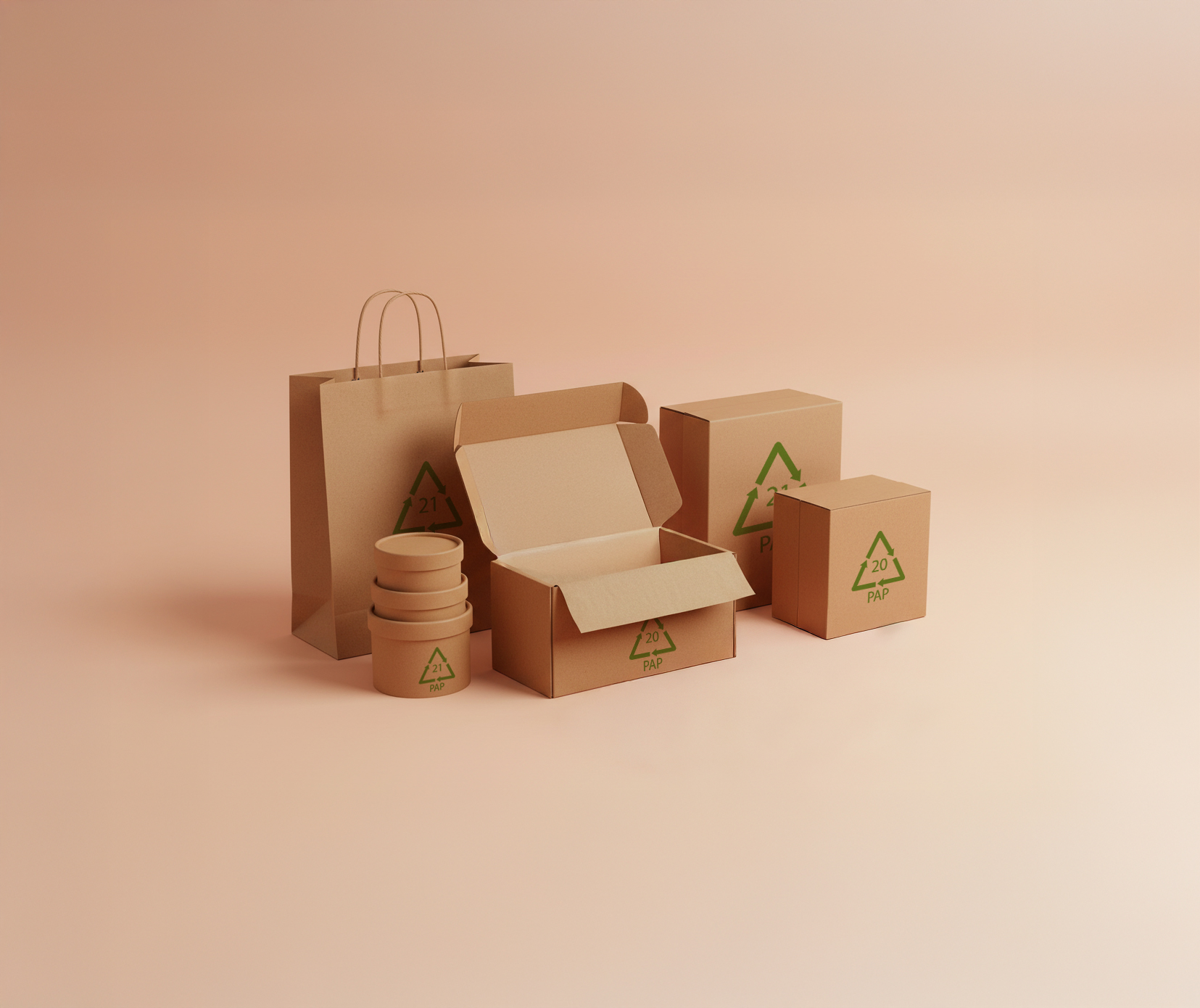
Sustainability has become one of the most loaded words in packaging. Everyone from indie skincare labels to global luxury houses is trying to decode what it really means. But when the conversation shifts to paper-based packaging—particularly folding cartons and rigid boxes—the question gets sharper: Which is more sustainable, and under what conditions? The reality is more nuanced than picking a winner.
Material & Structure: The First Layer of the Debate
On the surface, both folding cartons and rigid boxes share the same DNA. They are paper-based structures, typically manufactured from SBS (solid bleached sulfate), FBB (folding boxboard), or recycled board. But structurally they behave differently.
Folding cartons are lean by design. They use a single layer of paperboard, cut, scored, and glued into shape. Their footprint, both material and logistical, is small. Rigid boxes, on the other hand, are multi-component objects—board, wrap, and often adhesive or magnetic hardware. The complexity is what creates the luxury effect. But complexity has implications.
In sustainability terms, more layers mean more energy, more finishing steps, and potentially more difficulty during recycling. While both formats are technically recyclable, rigid constructions often require de-lamination or separation of components for ideal downstream recovery.
Logistics: Flat vs. Fully Formed
Logistics is where folding cartons flex. They ship flat—hundreds of units fit neatly into a single master carton. Warehousing, transport, and carbon footprint shrink as a direct result. Brands operating in D2C or subscription models consider this a strategic advantage, especially when margins are tight and warehouse space isn’t infinite.
Rigid boxes rarely enjoy this luxury. They typically ship fully formed, taking up volume long before they reach the customer. That wasted air in transit has a carbon cost. Collapsible rigid boxes attempt to close the gap, offering the premium unboxing feel without the inefficiencies of fully formed structures. They represent a hybrid future—luxury without logistical penalty.
Sustainability & Consumer Perception: Two Different Metrics
Here’s where the conversation turns psychological. Sustainability on paper isn’t always sustainability in mind. Consumers often interpret rigid boxes as more “valuable” and therefore more “keepable.” In luxury beauty, fragrance, chocolate, and accessories, rigid boxes are repurposed—stored in drawers, used as organizers, and integrated into personal spaces. Folding cartons rarely receive this second life.
Which raises a subtle question: Is a rigid box that lives on for five years more sustainable than a folding carton that’s recycled in five days? Sustainability metrics rarely factor emotional durability into their equations, but brand strategists quietly do.
Finishing & Additives: The Invisible Variables
Finishing can tilt the sustainability balance significantly. Hot foil stamping, lamination, spot UV, holographic films, and magnetic closures all introduce layers of complexity. For folding cartons, premium finishing is becoming more sustainable as suppliers shift to foil-recyclable and compostable coatings. Rigid boxes, however, can become sustainability liabilities when too many embellishments are stacked without consideration for recyclability.
Brands in 2025 are responding with restraint. In premium beauty, “quiet luxury” has replaced maximalism. Soft-touch coatings, micro-embossing, and minimal foil are increasingly preferred because they communicate refinement without overwhelming the sustainability narrative.
Price & Sustainability: A Convergence Point
The conversation isn’t purely ecological—it’s economic. Folding cartons are typically less expensive to produce at volume. For brands scaling D2C channels, sustainable choice and smart unit economics align naturally. Sustainability becomes not an add-on cost, but a built-in business logic.
Rigid boxes have a higher unit price, justified by perceived luxury. If sustainability aligns with price, it’s usually in the form of limited editions, gifting kits, PR mailers, and fragrance sets—categories where elevated experience outweighs environmental footprint.
So Which Is More Sustainable?
There isn’t a single winner. Instead, there are use cases:
- Sustainable for everyday retail & D2C → Folding cartons
- Sustainable for gifting & long-term use → Rigid with emotional durability
- Sustainable in logistics-sensitive channels → Folding cartons or collapsible rigid
- Sustainable for luxury perception → Rigid (but restrained finishes)
Sustainability is never just about material. It’s about total lifecycle—from production to shipping, to use, to disposal, and sometimes reuse.
The most sustainable choice in 2025 isn’t binary; it’s strategic. It asks:
“What does the packaging need to do, for whom, and for how long?”
And when framed that way, the question stops being “Which is better?”
and becomes “Which is better for this brand, this product, and this moment?”